
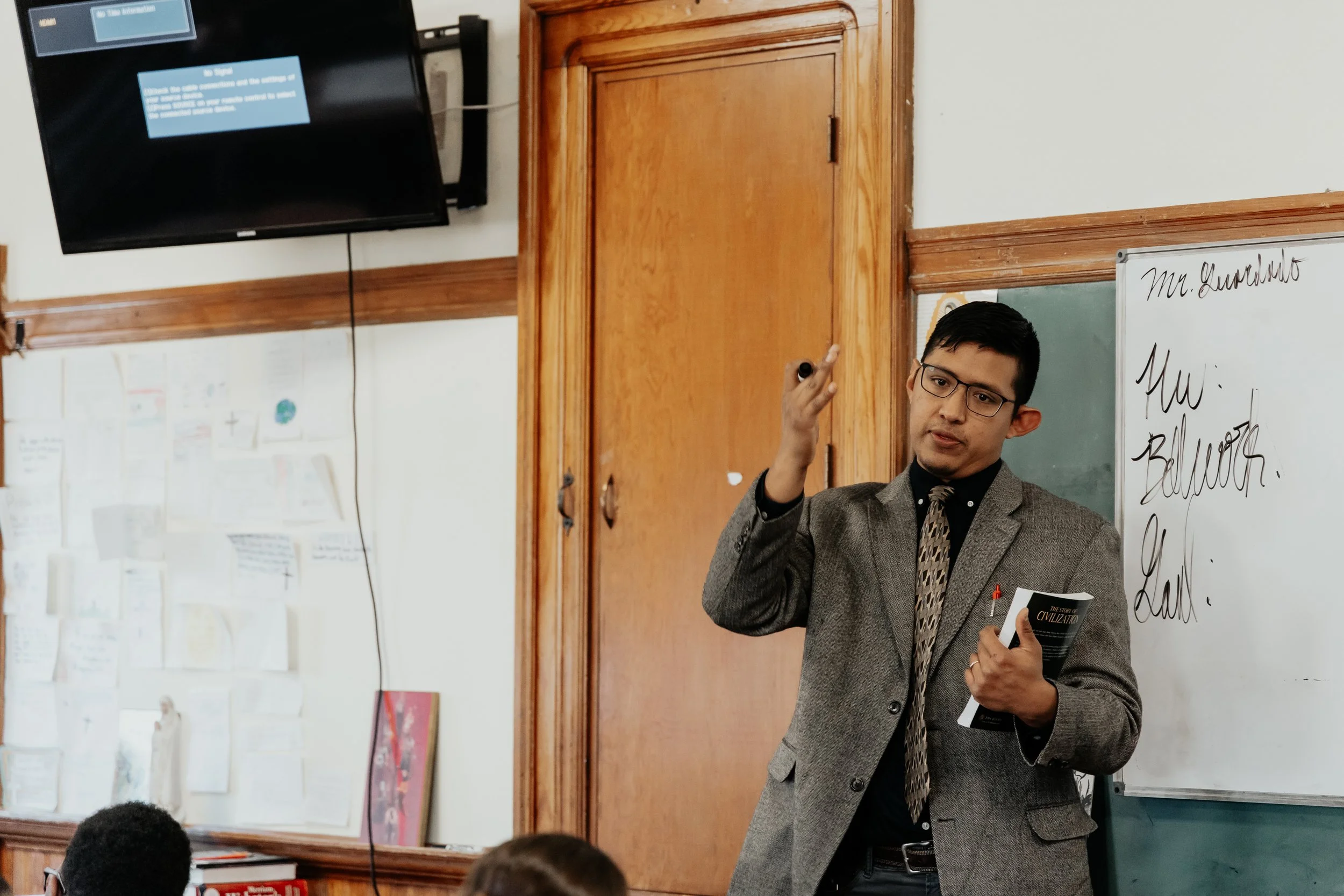
Why Classical Currciulum?
The word curriculum derives from the Latin word for a race course, for example, the Circus Maximus; thus, a curriculum presents the planned course of studies each student sets out to complete.
HFA offers a classical liberal arts curriculum consisting primarily of original texts that speak across the ages. The books are chosen for their great wisdom about human nature, the nature of the world, and the meaning of life. Occasionally, the original classics in the HFA curriculum are supplemented by excellent textbooks that are useful for reference, because they treat a subject matter in a systemized and linear manner.
The books in a classical curriculum are distinguished not for their antiquity, length, or complexity; rather, they are classical because their content is among the best that has ever been thought, said, or written. Such books contain much more than facts, information, or data. In an age with a superabundance of data, T. S. Eliot rightly asks, “Where is the wisdom we have lost in knowledge? Where is the knowledge we have lost in information?”
John Adams noted the hierarchy in subject matter when articulating his hopes for what his children and grand-children would study:
“I must study politics and war that my sons may have liberty to study mathematics and philosophy. My sons ought to study mathematics and philosophy, geography, natural history, naval architecture, navigation, commerce, and agriculture, in order to give their children a right to study painting, poetry, music, architecture, statuary, tapestry, and porcelain.”[1]
As Adams points out, students who have the opportunity to take a classical curriculum benefit not only from the great philosophers, mathematicians, scientists, and artists they study , but also from the generosity of those who sacrificed for the sake of their education.